Neptune is the eighth and farthest planet from the Sun in the Solar System. It is a gas giant and has a blue color due to the presence of methane in its atmosphere. Here is some more detail about Neptune:
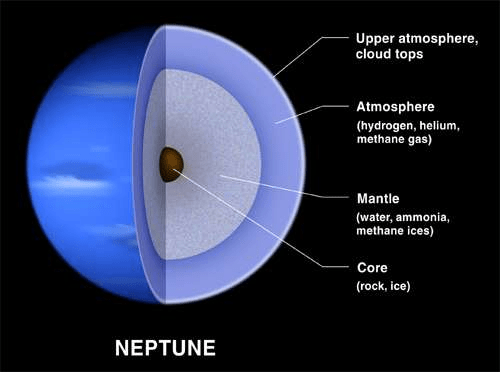
Physical Characteristics:
Diameter: 49,244 km
Mass: 1.02 x 10^26 kg
Density: 1.638 g/cm^3
Surface Temperature: -218°C
Number of Moons: 14 known moons
Atmosphere:
The atmosphere of Neptune is composed of hydrogen, helium, and methane.
The blue color of the planet is due to the absorption of red light by methane in the atmosphere.
The atmosphere also features large dark spots and white clouds, which are believed to be caused by high-speed winds of up to 2,100 km/h.
Magnetic Field:
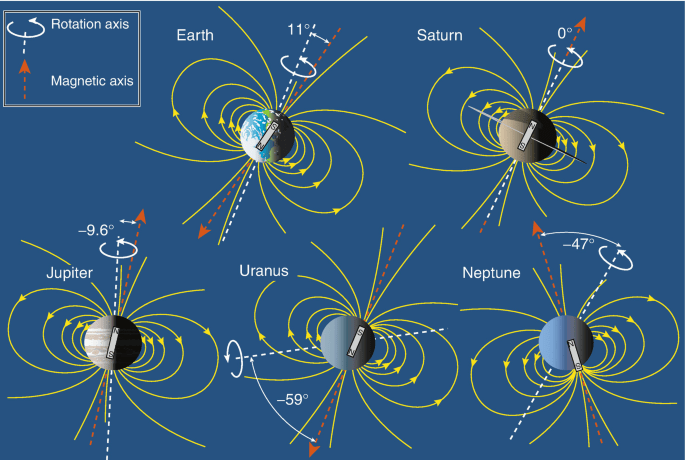
Neptune has the strongest magnetic field of all the planets in the Solar System.
It is tilted at an angle of 47 degrees relative to the planet’s axis of rotation.
The magnetic field is believed to be generated by convection currents in the planet’s outer core.
Moons:
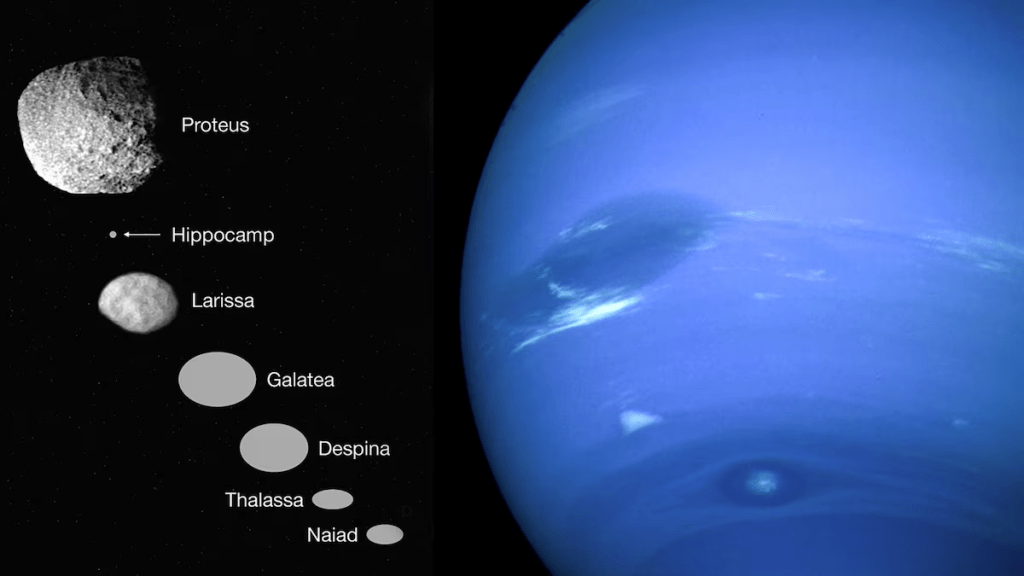
Neptune has 14 known moons, the largest of which is Triton.
Triton is one of the coldest objects in the Solar System, with a surface temperature of -235°C.
It is also the only large moon in the Solar System to orbit its planet in a direction opposite to the planet’s rotation.
Discovery and Exploration:
Neptune was discovered in 1846 by astronomers Urbain Le Verrier and John Couch Adams.
The planet has only been visited by one spacecraft, Voyager 2, in 1989.
Voyager 2 discovered six new moons and a number of previously unknown rings around the planet.
In conclusion, Neptune is a fascinating and mysterious planet, with a strong magnetic field, unique atmosphere, and interesting moons. Its discovery and exploration have added to our understanding of the Solar System and continue to inspire scientific curiosity.
Orbit and Rotation:
Neptune’s orbit is highly elliptical, meaning that its distance from the Sun varies widely over the course of its orbit.
One Neptunian year is equivalent to 164.8 Earth years, while one day on Neptune (the time it takes to complete one rotation on its axis) is just 16.11 hours.
Due to its rapid rotation, Neptune is visibly flattened at the poles and bulging at the equator.
Rings:
Like the other gas giants in the Solar System, Neptune has a ring system.
Its rings are composed of dust particles, ice particles, and small rocks, and are much fainter than the rings of Saturn.
There are five main rings and four fainter rings, named after astronomers who made significant contributions to the study of Neptune.
Exploration and Future Missions:
As mentioned earlier, Neptune has only been visited by one spacecraft, Voyager 2, in 1989.
There are currently no planned missions to Neptune, but there have been proposals for future missions, including an orbiter and a flyby mission.
These missions would aim to study the planet’s atmosphere, magnetic field, moons, and ring system in more detail.
Interesting Fact:
In 2011, a massive storm was observed in Neptune’s atmosphere, dubbed the “Great Dark Spot” reminiscent of Jupiter’s Great Red Spot.
However, as of Voyager 2’s flyby in 1989, the Great Dark Spot had disappeared and a different dark spot was observed. This suggests that Neptune’s atmosphere is highly dynamic and constantly changing.
Overall, Neptune remains a fascinating planet that continues to captivate scientists and the public alike. Its unique characteristics and mysterious nature make it an object of scientific study and discovery.

 "Explore, Engage, and Embrace: Unleash the Curiosity within and Discover Your Universe of Activities!"