
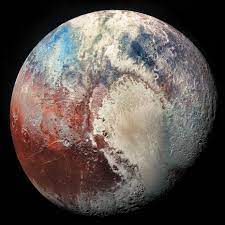
Pluto is a dwarf planet located in the Kuiper Belt, a region of our solar system beyond the orbit of Neptune. It was discovered in 1930 by astronomer Clyde Tombaugh, and for nearly 76 years, it was considered the ninth planet of our solar system. However, in 2006, the International Astronomical Union (IAU) redefined the term “planet,” and Pluto was reclassified as a dwarf planet. In this article, we’ll explore the fascinating history of Pluto and what we know about this small, distant world.

#1.Discovery of Pluto
Clyde Tombaugh discovered Pluto in 1930 while working at the Lowell Observatory in Arizona. He was tasked with finding a planet beyond Neptune, as astronomers had observed perturbations in the orbit of Uranus that suggested the presence of a ninth planet. After months of searching, Tombaugh found a small, dim object moving slowly across the sky. He confirmed that it was indeed a planet by comparing photographs taken at different times and measuring its position relative to the background stars.
#2.Naming of Pluto
The discovery of Pluto captured the public’s imagination, and newspapers held a contest to name the new planet. The name “Pluto” was suggested by an 11-year-old girl named Venetia Burney, who was interested in classical mythology. Pluto was the Roman god of the underworld, and the name seemed fitting for a planet so far from the sun.
#3.Characteristics of Pluto
Pluto is a small, icy world that is about two-thirds the size of Earth’s moon. It has a rocky core surrounded by a mantle of water ice and frozen nitrogen, methane, and carbon monoxide. The surface of Pluto is covered in a thin layer of methane and nitrogen ice, which gives it a bright, reflective appearance. The temperature on Pluto ranges from -375 degrees Fahrenheit (-225 degrees Celsius) at its coldest to -340 degrees Fahrenheit (-210 degrees Celsius) at its warmest.
#4.Orbit of Pluto
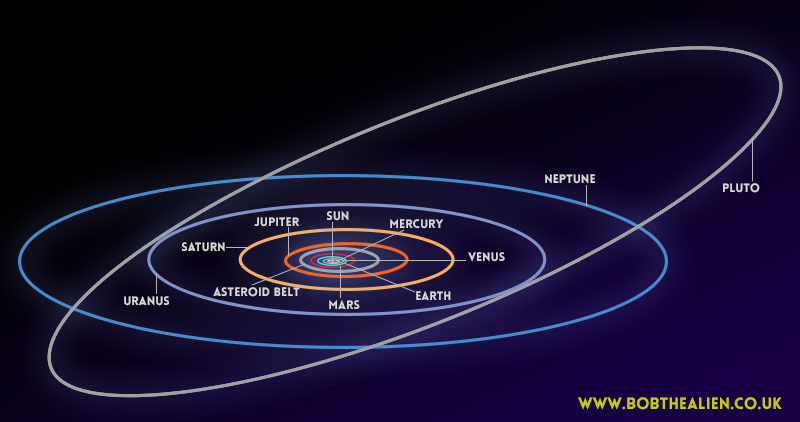
Pluto’s orbit is highly elliptical, meaning that it is much more elongated than the orbits of the eight planets. At its closest approach to the sun (perihelion), Pluto is 2.7 billion miles (4.4 billion kilometers) away. At its farthest point (aphelion), it is more than 4.6 billion miles (7.4 billion kilometers) from the sun. One orbit of Pluto takes about 248 Earth years.
#3.Moons of Pluto
Pluto has five known moons: Charon, Nix, Hydra, Kerberos, and Styx. Charon is the largest and closest moon to Pluto, and it is about half the size of Pluto itself. Charon and Pluto are tidally locked, meaning that they always face each other with the same hemisphere. The other four moons are much smaller and were discovered by the Hubble Space Telescope in the years following the discovery of Charon.

#4.New Horizons Mission
In 2006, NASA launched the New Horizons spacecraft to study Pluto and its moons up close. The spacecraft traveled for more than nine years and covered a distance of over 3 billion miles (4.9 billion kilometers) before reaching Pluto in July 2015. During its flyby, New Horizons collected data and images that revealed many new details about Pluto and its moons.
#5.New Discoveries
The New Horizons mission revealed that Pluto has a much more complex and dynamic surface than scientists had previously thought. The images showed a variety of features, including mountains, valleys, and plains, as well as a vast plain covered in nitrogen ice. The spacecraft also discovered a large, heart-shaped feature on Pluto’s surface that has been named Tombaugh
Regio in honor of Pluto’s discoverer. Scientists believe that the heart-shaped feature may be a giant impact basin, created by a collision with a large object early in Pluto’s history.
New Horizons also revealed that Pluto has a tenuous atmosphere made up mostly of nitrogen, with traces of methane and carbon monoxide. The atmosphere extends up to 1,000 miles (1,600 kilometers) above Pluto’s surface, and it is thought to be replenished by the sublimation of ices on the surface.
#6.Impact of Reclassification
Pluto’s reclassification as a dwarf planet in 2006 was controversial, and it sparked debate among astronomers and the public. Some argued that Pluto should still be considered a planet based on its size and historical status, while others supported the IAU’s definition and the recognition of other dwarf planets in the solar system.
Despite the controversy, the reclassification did not diminish the importance of Pluto as a scientific object of study. In fact, it led to renewed interest in the outer solar system and the Kuiper Belt, which is now recognized as a rich and diverse region of icy objects.
#7.Future Missions
The success of the New Horizons mission has inspired plans for future missions to the outer solar system. One proposed mission, called the New Horizons 2, would study another Kuiper Belt object called 2014 MU69. This object was discovered in 2014 and is thought to be one of the most primitive and pristine objects in the solar system.
Pluto may no longer be considered a planet, but its importance as a scientific object has only grown in recent years. The discovery of its complex surface, its atmosphere, and its moons has revealed much about the outer solar system and the processes that shaped it. As we continue to explore the Kuiper Belt and the icy objects that reside there, we are sure to learn even more about this fascinating and mysterious region of our solar system.
Pluto has also been studied by ground-based telescopes and other space missions. In 1978, the International Ultraviolet Explorer satellite observed Pluto and found evidence of a thin atmosphere. In 1988, the Hubble Space Telescope was used to make the first detailed images of Pluto, revealing its surface features and the presence of a large, dark spot.
In addition to scientific research, Pluto has also captured the public’s imagination and inspired works of art and literature. In 1931, Walt Disney created a cartoon character named Pluto, a mischievous dog named after the planet. In recent years, Pluto has been the subject of numerous science fiction stories and movies, as well as a popular meme based on the “Pluto is a planet” debate.
Despite its small size and distant location, Pluto remains a fascinating and important object of study in our solar system. Its discovery and reclassification have sparked new interest in the outer solar system and the diverse array of objects that inhabit it. As we continue to explore and learn more about Pluto and the Kuiper Belt, we are sure to gain new insights into the history and evolution of our solar system.
One of the most exciting discoveries made by the New Horizons mission was the presence of a diverse landscape on Pluto’s surface. The spacecraft captured images of mountains, valleys, plains, and glaciers that rival the diversity of any planet in our solar system. The most prominent feature on Pluto’s surface is a large, heart-shaped region called Tombaugh Regio in honor of Pluto’s discoverer. Scientists believe that the heart-shaped feature may be a giant impact basin, created by a collision with a large object early in Pluto’s history.
New Horizons also revealed that Pluto has a tenuous atmosphere made up mostly of nitrogen, with traces of methane and carbon monoxide. The atmosphere extends up to 1,000 miles (1,600 kilometers) above Pluto’s surface, and it is thought to be replenished by the sublimation of ices on the surface.
Pluto’s system of moons has also been a subject of study. In addition to Charon, which was discovered in 1978, New Horizons discovered four small moons: Styx, Nix, Kerberos, and Hydra. These moons are thought to have formed from the debris of a collision between Pluto and another object early in its history.
The reclassification of Pluto as a dwarf planet in 2006 was controversial, and it sparked debate among astronomers and the public. Some argued that Pluto should still be considered a planet based on its size and historical status, while others supported the IAU’s definition and the recognition of other dwarf planets in the solar system.
Despite the controversy, the reclassification did not diminish the importance of Pluto as a scientific object of study. In fact, it led to renewed interest in the outer solar system and the Kuiper Belt, which is now recognized as a rich and diverse region of icy objects.
The success of the New Horizons mission has inspired plans for future missions to the outer solar system. One proposed mission, called the New Horizons 2, would study another Kuiper Belt object called 2014 MU69. This object was discovered in 2014 and is thought to be one of the most primitive and pristine objects in the solar system.
In conclusion, Pluto may no longer be considered a planet, but its importance as a scientific object has only grown in recent years. The discovery of its complex surface, its atmosphere, and its moons has revealed much about the outer solar system and the processes that shaped it. As we continue to explore the Kuiper Belt and the icy objects that reside there, we are sure to learn even more about this fascinating and mysterious region of our solar system.

 "Explore, Engage, and Embrace: Unleash the Curiosity within and Discover Your Universe of Activities!"