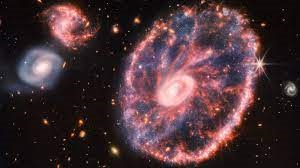
Our best theory for the origin of the universe is the Big Bang Theory.
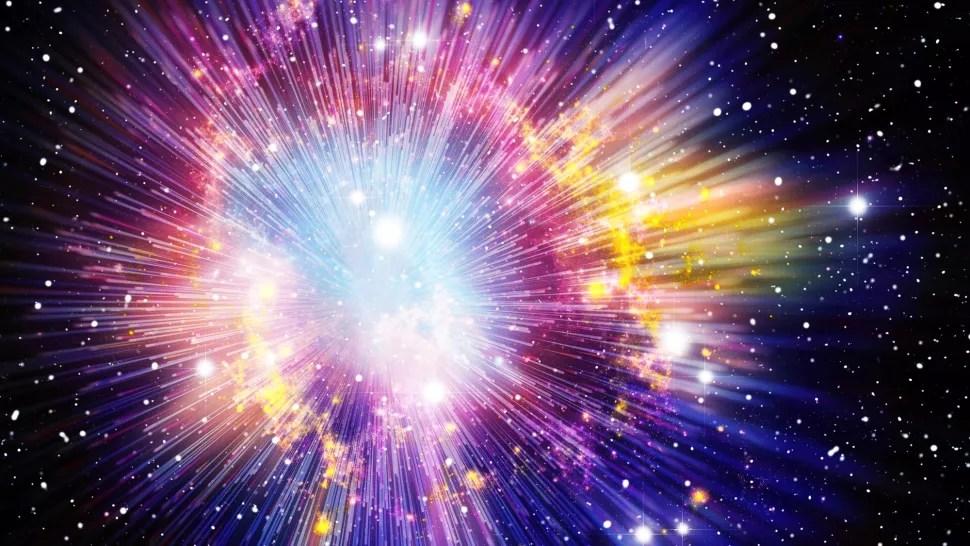
The most popular theory for how the universe came into being is called the Big Bang Theory. Simply expressed, it states that the universe as we currently understand it originated from an unimaginably hot and dense single point and expanded over the course of 13.7 billion years, first at unfathomable speeds and subsequently at a more palpable rate.
The majority of what we know about the Big Bang comes from mathematical formulas and models because current technology does not yet allow astronomers to look back at the creation of the universe. Nonetheless, the “echo” of the expansion may be observed by astronomers thanks to a phenomena called the cosmic microwave background.
Although the idea is accepted by the majority of astronomers, some theorists offer alternate
THE BIG BANG: THE BIRTH OF THE UNIVERSE
Around 13.7 billion years ago, everything in the entire universe was condensed in an infinitesimally small singularity, a point of infinite denseness and heat.
Suddenly, an explosive expansion began, ballooning our universe outwards faster than the speed of light. This was a period of cosmic inflation that lasted mere fractions of a second — about 10^-32 of a second, according to physicist Alan Guth’s 1980 theory that changed the way we think about the Big Bang forever.
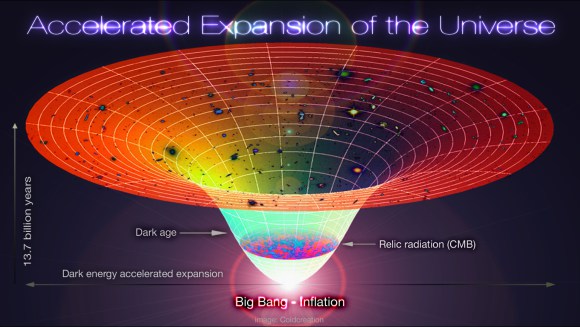
When cosmic inflation came to a sudden and still-mysterious end, the more classic descriptions of the Big Bang took hold. A flood of matter and radiation, known as “reheating,” began populating our universe with the stuff we know today: particles, atoms, the stuff that would become stars and galaxies and so on.
According to NASA, all of this occurred during the first second after the universe was created, when everything was still incredibly hot at a temperature of roughly 10 billion degrees Fahrenheit (5.5 billion degrees Celsius) (opens in new tab). The basic materials that would later become the components of everything that is there today, such as neutrons, electrons, and protons, were present in the universe at this time.
It would have been impossible to truly see through this early “soup,” as it was unable to contain visible light. According to NASA, the free electrons would have caused light (photons) to scatter in a similar way to how sunlight does when it hits water droplets in clouds. Yet, over time, these free electrons collided with nuclei to form neutral atoms or atoms with an equal number of positive and negative charges.
 "Explore, Engage, and Embrace: Unleash the Curiosity within and Discover Your Universe of Activities!"